I know it came only came out two years ago exclusively for the PS2, but it's oh so good that it deserves a place among the classics.
the Bond like intro alone makes this game for me.
bon appetite.

My thanks to the CBR For the interesting article.
Enjoy
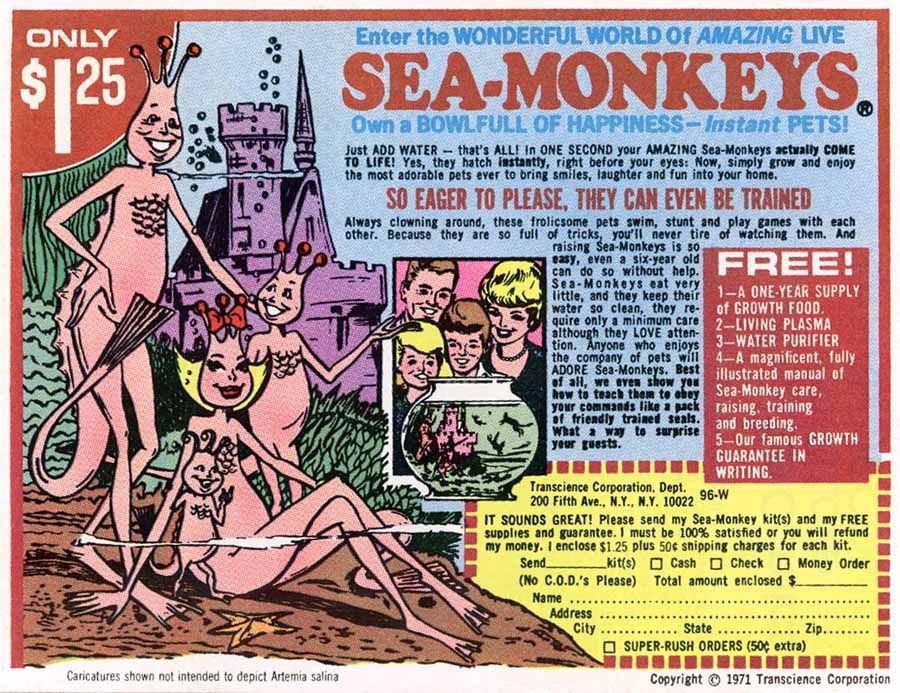
COMIC URBAN LEGEND: Joe Orlando illustrated the famous depictions of Sea Monkeys.
STATUS: True
In many ways, the early 60s were Joe Orlando’s “lost years.” He left EC in 1956, where he made many classic contributions to comic science fiction. After working at Classics Illustrated until 1959, Orlando spent the 60s working at a variety of places, until finally settling down in 1968 when he became an editor at DC Comics. He did some work at Mad Magazine, he did some comic strip writing, and he did a lot of commercial advertisement (mainly for toys).
Meanwhile, in the early 60s, comic book marketer Harold von Braunhut had a product that was selling well enough, but not doing great business. Called “Insant Life,” von Braunhut debuted the product in 1957. What is was a crustacean that von Braunhut discovered that lived in suspended animation until they were born. They could live in this status for YEARS. Therefore, this was a perfect opportunity for von Braunhut. He would package a few of these crutaceans (which, while similar to brine shrimp, were NOT, in fact, brine shrimp) and sell it as “Instant Life.” However, a few years later, in an attempt to jump start the product, von Braunhut decided to rename the product “Sea Monkeys.”
And along with the new name, there was the following, soon to be famous, illustration (click on the photo for a larger version)
The illustration, though never credited to him, was by Orlando. Sales of the newly title product skyrocketed, no doubt in part due to Orlando’s illustration.
Well, that’s it for me this week!
 | 40. Milner's Deuce Coupe Type of car: Customized 1932 Ford Coupe Special features: Legendary license plate number Appears in: American Graffiti George Lucas was a hot rod enthusiast, and this film based on his own teenage years in Modesto, California definitely shows that. John Milner's 1932 Ford introduced a whole new generation to this type of old style hot rod. |
 | |
 | 39. Cobretti's Mercury Type of car: Customized 1950 Mercury Monterey Special features: Custom paint, nitrous injection system Appears in: Cobra Apart from relatively cartoonish violence, Cobretti's 1950 Merc is probably the most memorable thing about the whole movie. Sadly, the car is completely destroyed by the end of the film. |
 | |
 | 38. Tucker Torpedo Type of car: 1948 Tucker Sedan Special features: Directional front headlight, rear engine, padded dash Appears in: Tucker: The Man and His Dream In an attempt to start his own manufacturing company, Preston Tucker came up with a car with innovative features and radical styling. The company closed down amid fraud allegations, and only 51 cars were ever made, making the "Tucker Torpedo" a very rare and collectible car. |
 | |
 | 37. Flounder's brother's Lincoln Type of car: 1964 Lincoln Continental Special features: Custom bodywork and paint Appears in: National Lampoon's Animal House While on the ill-fated road trip with Otter, Boon, and Pinto, freshman Delta pledge Flounder severely damages his brother Fred's Lincoln Continental. But no matter, D-Day "fixes" it just in time for Faber's annual Homecoming parade. |
 | |
 | 36. Charlie Babbit's Buick Type of car: 1949 Buick Roadmaster Convertible Special features: Can be driven slow on the driveway Appears in: Rain Man This classic convertible is the sum total of Charlie Babbitt's inheritance, after his father passes away. It's not the same as getting $3 million, but the car's true value lies in bringing Charlie together with the brother he never knew he had. |
 | |
 | 35. Richard's classic Plymouth Type of car: 1967 Plymouth Belvedere GTX Special features: Can carry stunned deer in back seat Appears in: Tommy Boy Another road movie with a classic car, but this one gets more and more abuse as the movie goes one. They lose the top. And the hood. And a door. And finally the car catches fire. But at least Tommy and Richard save the company... |
 | |
 | 34. Shaggin' Wagon Type of car: 1984 Ford Econoline Special features: Custom bodywork and exterior fur lining Appears in: Dumb and Dumber Ask Harry and Lloyd; there's nothing like having a company car. Even if it does look like a giant sheep dog. |
 | |
 | 33. Bumblebee Type of car: 1977/2009 Chevrolet Camaro Special features: V8 engine, robot mode Appears in: Transformers Although previously seen as a Volkswaken Beetle, Bumblebee makes his film debut as a 1977 Camaro. But he's sensitive about how he looks, so he changes himself in to a 2009 Camaro. What else can he change into? A giant robot, natch! |
 | |
 | 32. Charlie's getaway MINIs Type of car: 2003 MINI Cooper S Special features: Gold bar hauling capacity Appears in: The Italian Job (2003) When BMW reintroduced the MINI in 2000, it was only a matter of time before someone got around to remaking The Italian Job. The action moves from Rome to Los Angeles, but the idea is the same; watching MINIs outrun anyone trying to chase them. |
 | |
 | 31. Cole Trickle's race car Type of car: 1990 Chevrolet Lumina NASCAR Special features: NASCAR racing specs Appears in: Days of Thunder It gets wrecked and rebuilt, and sees multiple paint schemes over the course of the film, but that's to be expected for a typical NASCAR racing machine. |
 | |
126 (tie). Roger Stern’s Doctor Strange – 68 points
Doctor Strange #46-62, 65-75
Actually, this is Stern’s second run on the title, I think. Was the first time long enough for a run? Anyhow, this was a great series, particularly when Paul Smith was drawing it. Hoo boy, that was some good comics - but Stern was lucky to work with a number of great artists during his run. A memorable storyline involved the destruction of all vampires.
126 (tie). Larry Hama’s GI Joe – 68 points (1 first place vote)
G.I. Joe #1-155, plus annuals and specials
Doing a toy tie-in is not the easiest creative environment, but for almost ten years, Larry Hama made it work, with a variety of silly plotlines he had to use, he always had his characters act as realistic as possible under the circumstances, and he made Snake Eyes a cool character more than anyone else.
126 (tie). Mike Grell’s Sable – 68 points
Jon Sable, Freelance #1-56
Jon Sable, Freelance is a very typical Mike Grell story- heavy character work, a lot of action, and mature themes (not to mention great artwork). Grell never pandered to his readers - you got what he thought was interesting, whatever that may be, and I admire that.
125. Sam Kieth’s The Maxx – 70 points
The Maxx #1-35
Bill Loebs’ early involvement on this series cannot be underestimated (what can be underestimated is that the Maxx began in this horrible Image one-shot called Darker Image). This was a tremendously quirky book that had amazing Kieth artwork and some strong character moments.
123 (tie). Matt Wagner and Steve Seagle’s Sandman Mystery Theatre – 71 points (1 first place vote)
Sandman Mystery Theatre #1-60
Character was king in this series, as well, which was set during the Golden Age, and made Dian Belmont one of the best female characters in comics. Working with Guy Davis on art often sure doesn’t hurt the stories! Wagner left after #60, but Seagle wrote the book until it ended at #70.
123 (tie). Steve Englehart’s Captain America – 71 points
Captain America #153-167, 169-186
Englehart did a lot of innovative stuff on this title, like having Captain America give up his identity, take on a new identity, and also the famous storyline that ended with President Nixon killing himself because he was found out as the head of the Secret Empire. Powerful work, but also this was not all that different from other superhero comics so that a typical superhero fan couldn’t enjoy it, as well.
122. Peter David’s X-Factor (Second run) – 72 points
X-Factor #1-current (#30)
This began with the Madrox mini-series, and continued to this dark series starring Madrox as the head of X-Factor Investigations, which is a group of various mutant characters solving crimes. Really, though, the point of the comic is just watching everyone interact. One of David’s stronger works, and we’re lucky to have it coming out currently.
120 (tie). Jim Steranko’s Nick Fury - 74 points
Strange Tales #155-168, Nick Fury: Agent of S.H.I.E.L.D. #1-5
Steranko just cut loose on his SHIELD storylines, and they were both immensely enjoying while amazing to look at. Steranko had a great sense for design, and he really laid these stories out beautifully.
120 (tie). John Rogers’ Blue Beetle – 74 points (1 first place vote)
Blue Beetle #1-14, 16-20, 22-25
Rogers had a hard task, doing the new Blue Beetle title, but his throwback superhero tales, along with a keen eye for inventing good supporting cast members, on top of a likable star, have made this one of the most enjoyable superhero comics DC has to offer.
119. Peter David and Todd Nauck’s Young Justice – 75 points
Young Justice #1-55, plus a #1,000,000 and some specials
Young Justice was Peter David just having a good time and some laughs, with Todd Nauck along for the ride the whole time. There were parodies and puns galore, as well as some occasional hard-hitting stories, which touched on racism and stuff like that. It was a strong book which was sadly canceled in favor of Teen Titans. This is the last time Impulse was good.
116 (tie). J. Michael Straczynski’s Amazing Spider-Man – 76 points
Amazing Spider-Man (Vol. 2) #30-58, Amazing Spider-Man (Vol. 1) #500-545
JMS’ run on Amazing Spider-Man helped to revitalize the Spider-Man line, turning what was a book in sales trouble into one of Marvel’s highest-selling titles. He had a good chemistry with his artists, especially the initial run, with John Romita, Jr. as artist.
116 (tie). Gail Simone’s Birds of Prey - 76 points (1 first place vote)
Birds of Prey #56-90, 92-108
A fine follow-up to Chuck Dixon’s origination of the team. Like most great runs, Simone highlighted characterization, and stressed the development of both Black Canary and Huntress during the series, as well as the closer bond that the three main female leads developed. Also a sizable amount of humor.
116 (tie). Robert Kanigher and Joe Kubert’s Sgt. Rock - 76 points (1 first place vote)
A whole pile of Our Army at War and Sgt. Rock comics - too many different issues to list.
Strong, solid war stories with gritty, dynamic artwork by Kubert. Not many multi-issue arcs, so Kanigher had to come up with new stories constantly, which he did with a great amount of ingenious plot ideas (for a series that had such a basic premise, Kanigher got as much out of it as he could).
115. Howard Chaykin’s American Flagg 43 – 77 points
(writer) American Flagg #1-26, #38-32
(penciler) American Flagg #1-12, 15-26
One of the first “modern” superheroes of the 1980s, featured great artwork by Chaykin as well as an engaging story. Perhaps the first time oral sex was shown in a comic book.
114. Marv Wolfman and Gene Colan’s Tomb of Dracula– 78 points
Tomb of Dracula #7-70, plus Annuals
A rousing action epic, with incredibly moody artwork by Colan and his longtime inker, Tom Palmer. What Wolfman did best in this run was introducing new characters and developing both them and the established characters he inherited. Hannibal King, Blade and Frank Drake all become multi-faceted intriguing characters, and Dracula was always there, too, being evil and cool.
113. Scott Lobdell’s Generation X – 79 points
Generation X #1-28, plus the four Age of Apocalypse issues
Lobdell introduced original characters, which was a big deal at the time, and Lobdell and artist Chris Bachalo (who drew most of Lobdell’s run) did a marvelous job coming up with characters that seemed a bit out of place in the typical world of the X-Men. Bachalo did particularly nice work on Skin and Chamber. A lot the development of Emma Frost for Morrison’s run came from this run.
112. Katsuhiro Ōtomo Akira – 80 points
Young Magazine #24 (1982)- #28 (1990), Published in the US in Akira #1-38
Otomo’s work on Akira was the bridge he needed from working in manga to working in film and television, and you can see that ability in the majestic work that often appears in Akira - it is widescreen designs and drawings - all with an intriguing plot.
111. Ed Brubaker/Matt Fraction’s Iron Fist – 83 points
The Immortal Iron Fist #1-current (#14)
Massive roller coaster ride of action, with one of the better new characters (the “Golden Age” Iron Fist) to come along in awhile. Very nice art throughout most of the series. This is a dynamic book with a number of good character moments, as well.
110. Grant Morrison/Mark Waid/Greg Rucka/Geoff Johns’ 52 - 85 points
52 #1-52
Yes, it only lasted a year, but if a book is over 50 full issues, I figure I can count it as an ongoing. This series started slow, but soon built up so much momentum that the final half was like a massive avalanche of cool moments, all set up with the deft characterization work each writer did with the fourth-string characters who starred in 52.
109. Denny O’Neil and Neal Adams’ Batman - 87 points
Detective Comics - #395, 397, 400, 402, 404, 407-408, 410 & Batman #232, 234, 237, 243-245, 251, 255
While spilt up over the early 1970s, O’Neil and Adams still had a bit of a run, where Adams’ conception of Batman became the definitive look for Batman in the 1970s. This run tried to take Batman back to a darker style (after the camp of the TV series), along with stellar artwork by Adams. It was during their run that Ra’s al Ghul was introduced.
107 (tie). Mark Waid and Ron Garney’s first run on Captain America – 89 points
Captain America #444-454
Followed up the rather disappointing end of Gruenwald’s run with a bombastic flourish, as the title was suddenly filled with action and intrigue. The idea of returning Sharon Carter to the book was brilliant, and outside of a few issues where his inkers seemed to not be doing him any favors, Ron Garney’s art was incredibly dynamic. This book was constantly moving and had a harder edge to Cap that hadn’t been seen since Steranko (like threatening to chop Red Skull’s head off, then actually chopping his arm off). It was a real shame when this was cut-off by Heroes Reborn. A year later, they got back together for a new volume of Cap, but while they were okay comics, the spark clearly had gone.
107 (tie). Dan Abnett and Andy Lanning’s Legion – 89 points (4 first place votes)
Legion of Superheroes #122-125, Legion Lost #1-12, Legion: Worlds #1-6, The Legion #1-33
Abnett and Lanning joined the Legion with artist Olivier Coipel, and right from the get-go, you knew this was a vastly different take on the Legion (more akin to Giffen’s Legion). They highlighted this by ending the regular series after their first arc and launching two mini-series that bridged the gap to their new series. First, Legion Lost, where a small group of the Legion are trapped in a faraway galaxy, and secondly, Legion Worlds, where we catch up on the various worlds in the Legion universe (and the Legionnaires on those worlds). This all leads to the ongoing series, The Legion, where Abnett and Lanning early on pull a Levitz/Giffen, and update a modern day DC villain to the future, in a rather brilliant move.
105. Dan Slott’s She-Hulk – 90 points
She-Hulk Vol. 3 #1-12, She-Hulk Vol. 4 #1-21
Dan Slott took over She-Hulk, who had pretty much fell to the wayside by this time (she had been without a series for about 10 years), and tried a new take. He would highlight the lawyer side of her character, and turn the book into a superhero take on Ally McBeal. It was a wonderful high concept, and it worked out well, especially with Slott’s hilarious sense of humor. Continuity would often be the butt of jokes, and after the first series fizzled out, sales-wise, Marvel decided to give him a second volume with more fanfare. That series did better, and it still continues today, although Slott left it recently to take over Amazing Spider-Man.
106. Brian K. Vaughan and Tony Harris’ Ex Machina – 92 points (1 first place vote)
Ex Machina #1-current (#36)
Ex Machina is Brian K. Vaughan’s take on what a superhero in the real world would appear like, as well as what would happen if a former superhero became Mayor of New York. In doing so, Vaughan gets to make points about superheroes AND politics (as opposed to politics and poker) while being ably assisted by Tony Harris’ realistic artwork. They took an interesting approach vis a vis fill-ins. Rather than having fill-in issues, they would have one-shots by other artists to fill-in. This way, Harris would be the only artist to draw Ex Machina proper.
104. Frank Miller’s Sin City – 93 points (1 first place vote)
Dark Horse Fifth Anniversary Special, Dark Horse Presents #51-62, then a pile of mini-series, including A Dame to Kill For, The Big Fat Kill and That Yellow Bastard
Sin City started off with a bang in Dark Horse Presents, as we saw the life of the gruesome Marv in this equally gruesome city. Later adventures brought in other characters with similarly gruesome tales of lust, betrayal and revenge. Oh, and lots of violence! Lots and lots of violence. Here, Miller truly perfected his noir art style, and the recent film adaptation of the work kept Miller’s art intact, showing just how cinematic Miller was on this series. A beautifully drawn series of horrible acts.
103. Jim Starlin’s Dreadstar – 94 points (1 first place vote)
Dreadstar #1-26 (Epic Comics), Dreadstar #27-40 (First Comics), plus some annuals and original graphic novels and the Metamorphosis Odyssey from Epic Illustrated
For a man with quite a few epics, Dreadstar probably was Starlin’s finest - or at least his most realized. He had 40 issues to develop the story of Vanth Dreadstar (the lone survivor of our galaxy) and his band of pirates against the bloody war between the Church of The Instrumentality and the Monarchy. In a lot of ways, this was a continuation of Starlin’s Warlock run, only with different characters, but it was a mature, often depressing work, with wonderful artwork by Starlin. What is striking about the work is that it follows the various changes that happen in the “real world,” but are often left unseen in fiction (The Walking Dead was also designed for this point - showing what happens AFTER the end of most zombie films). What happens when the rebels actually WIN? How do things change? It’s Starlin’s most mature work, and it really could use a full trade paperback collection. Luke McDonnell, by the way, drew the last 8 issues or so, the ones detailing what happens AFTER the war is won. It is darker, so it makes sense to use a darker artist like McDonnell.
Okay, that’s it!